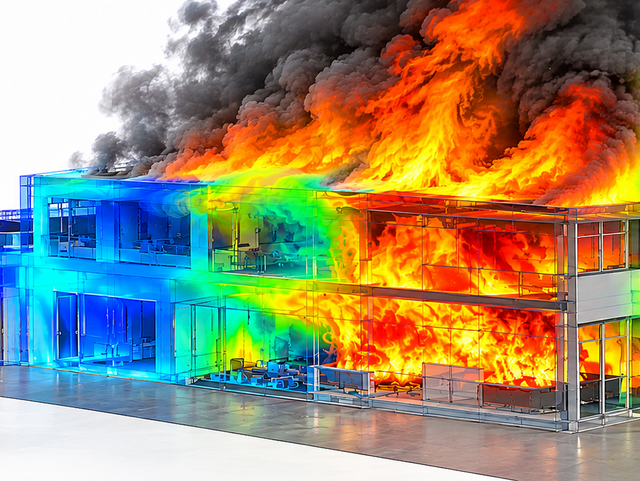

Fires and explosions follow the principles of chemistry and physics, which means that even a complex incident can be analysed with scientific accuracy. Neale Consulting uses computer fire modelling to show how a fire grew, how smoke moved, and how the systems in the building performed, so that theories about the incident can be tested against the evidence.
How Our Fire Modelling Works
We begin with a detailed examination of the site and use laser scanning to create a three-dimensional point cloud of the scene. That is turned into a computer fire dynamics model, in which millions of calculations simulate fire growth, smoke spread, suppression system performance, and thermal damage. The result is a fire simulation you can see.
What Fire Modelling Shows
Neale Consulting’s fire modelling solution can allow you to see:
- Fire Growth & Fire Spread Modelling: how the fire developed and moved through the space.
- Smoke Movement: how smoke travelled, and how it affected visibility and conditions in the building.
- System Effectiveness: how detection, sprinklers, and other suppression systems performed, including fire sprinkler modelling.
- Thermal Damage: where the heat damaged the structure and contents.
- Conditions for Occupants: whether people in the building could have escaped safely.
- Event Timelines: a sequence of events that can be compared with witness accounts and records.
When Clients Use It
Fire modelling supports insurers, legal professionals, energy operators and regulators by turning technical complexity into clear, defensible analysis for:
- Claims & Litigation: testing competing theories of origin and spread, and showing the result clearly to a mediator, judge or jury.
- Fire Protection Disputes: comparing how a system should have performed with how it actually did.
- Design Improvements: learning from an incident so that it is less likely to happen again.
Need a fire reconstructed?
Then tell Neale Consulting about the incident and we can advise on whether modelling would help. Contact us now.
How can we help you?